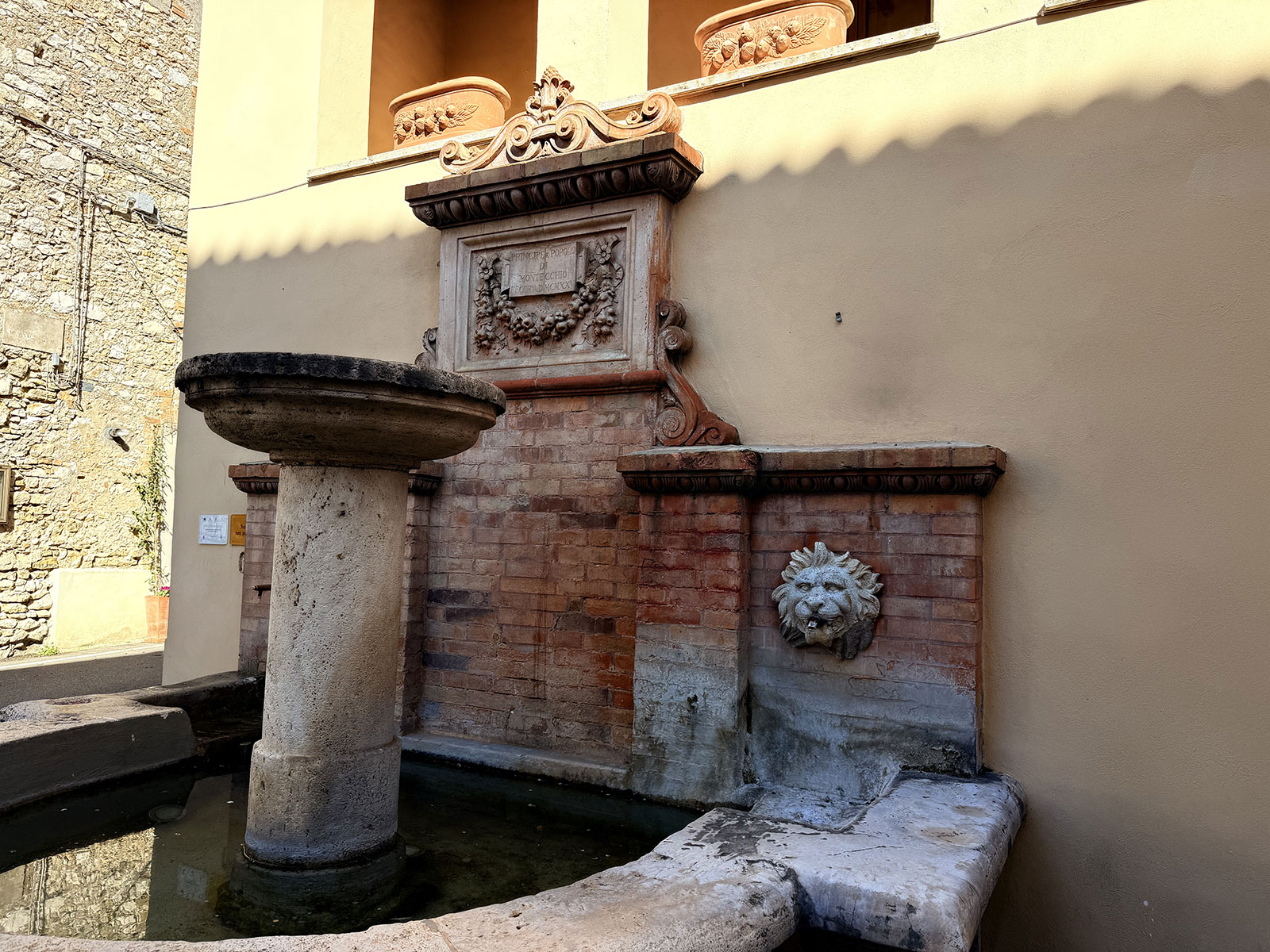
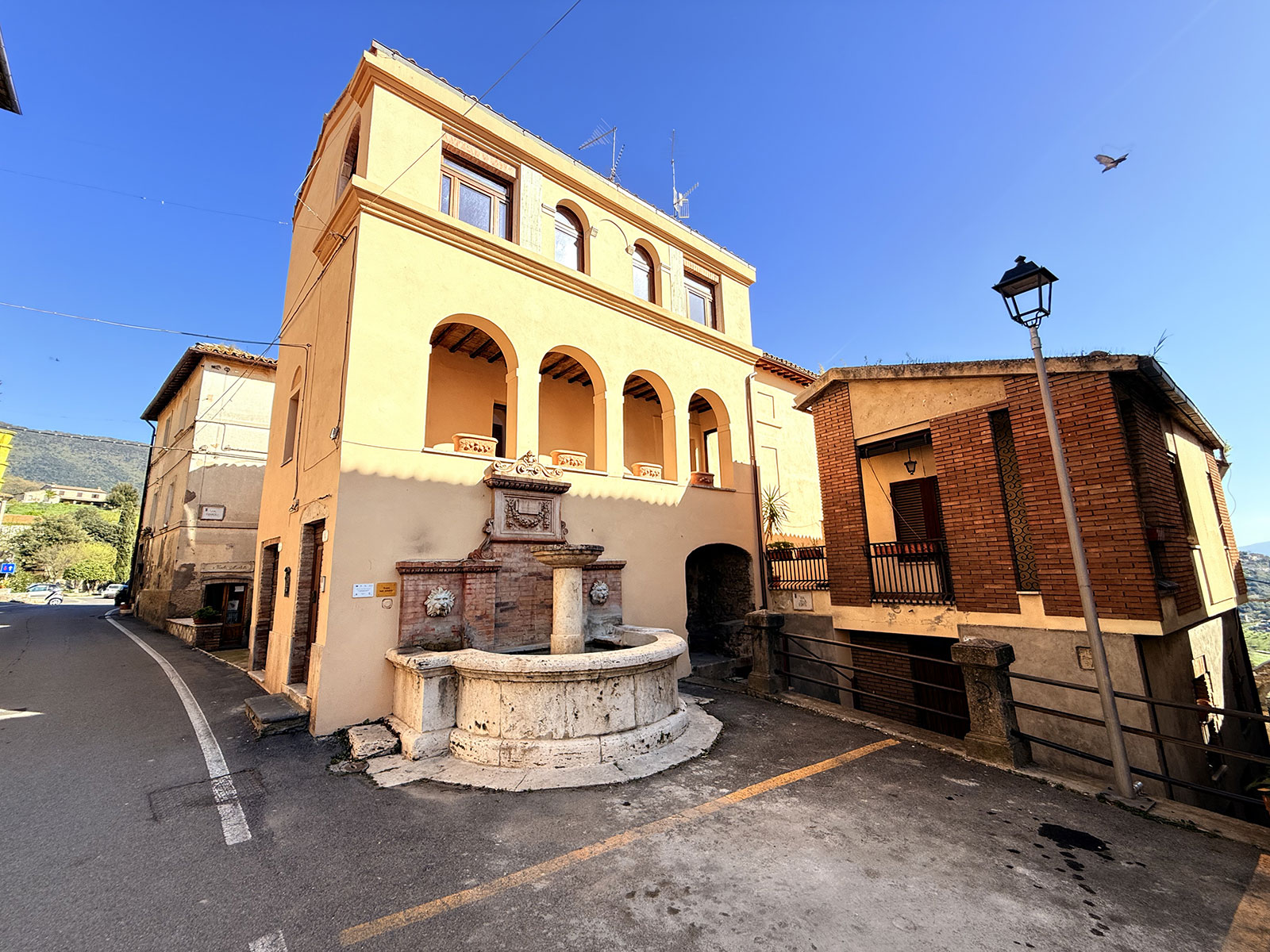
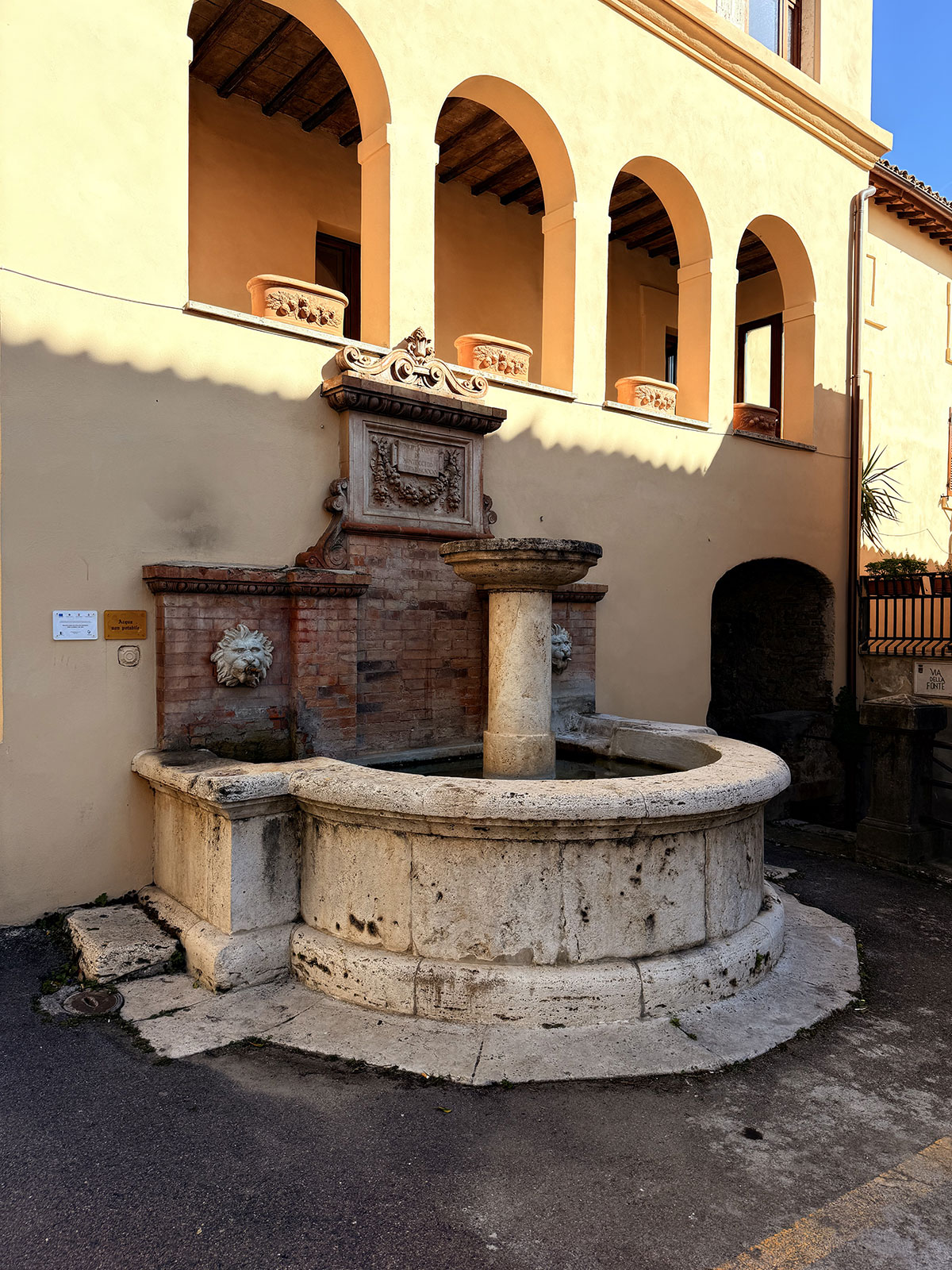
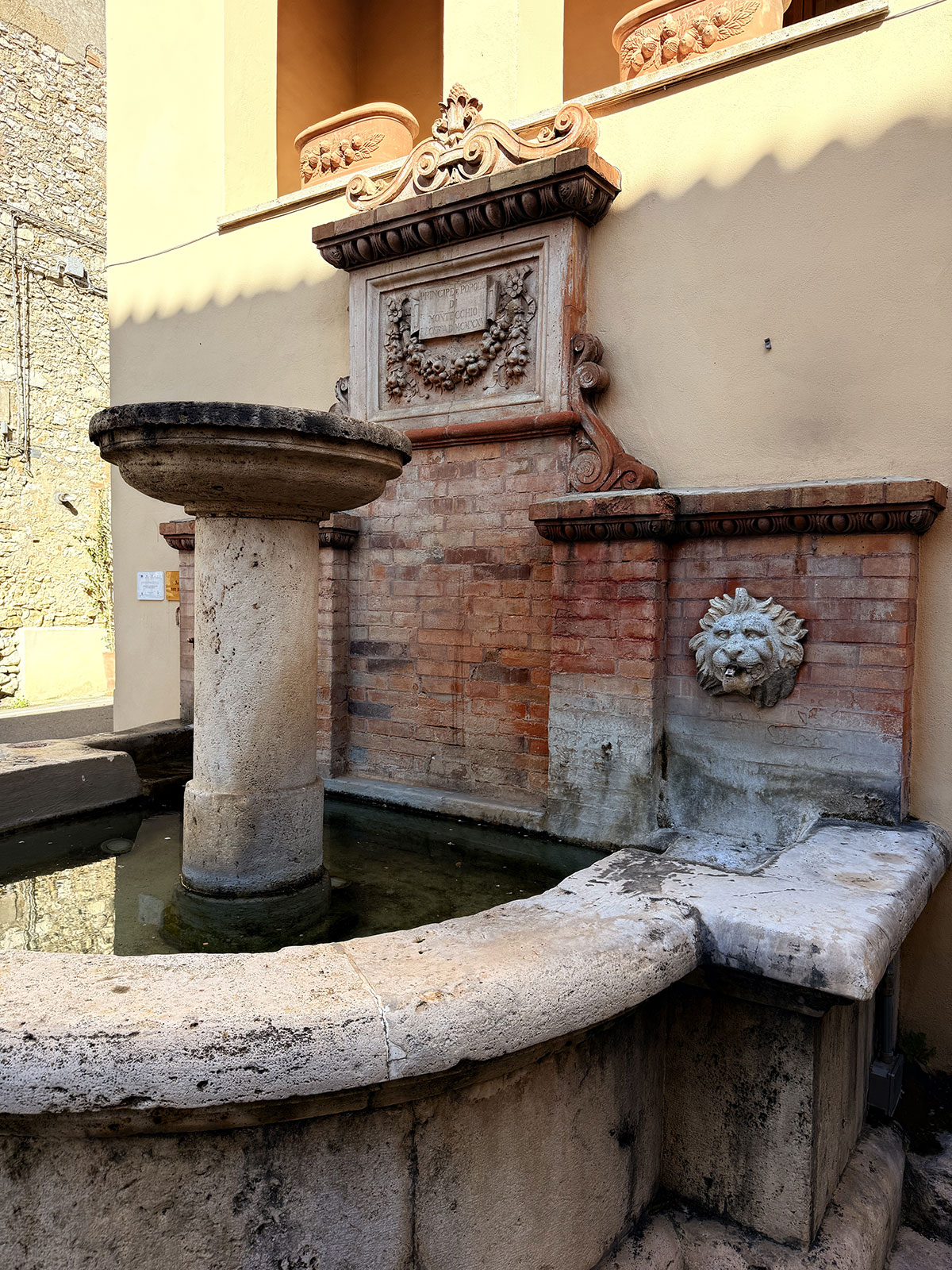
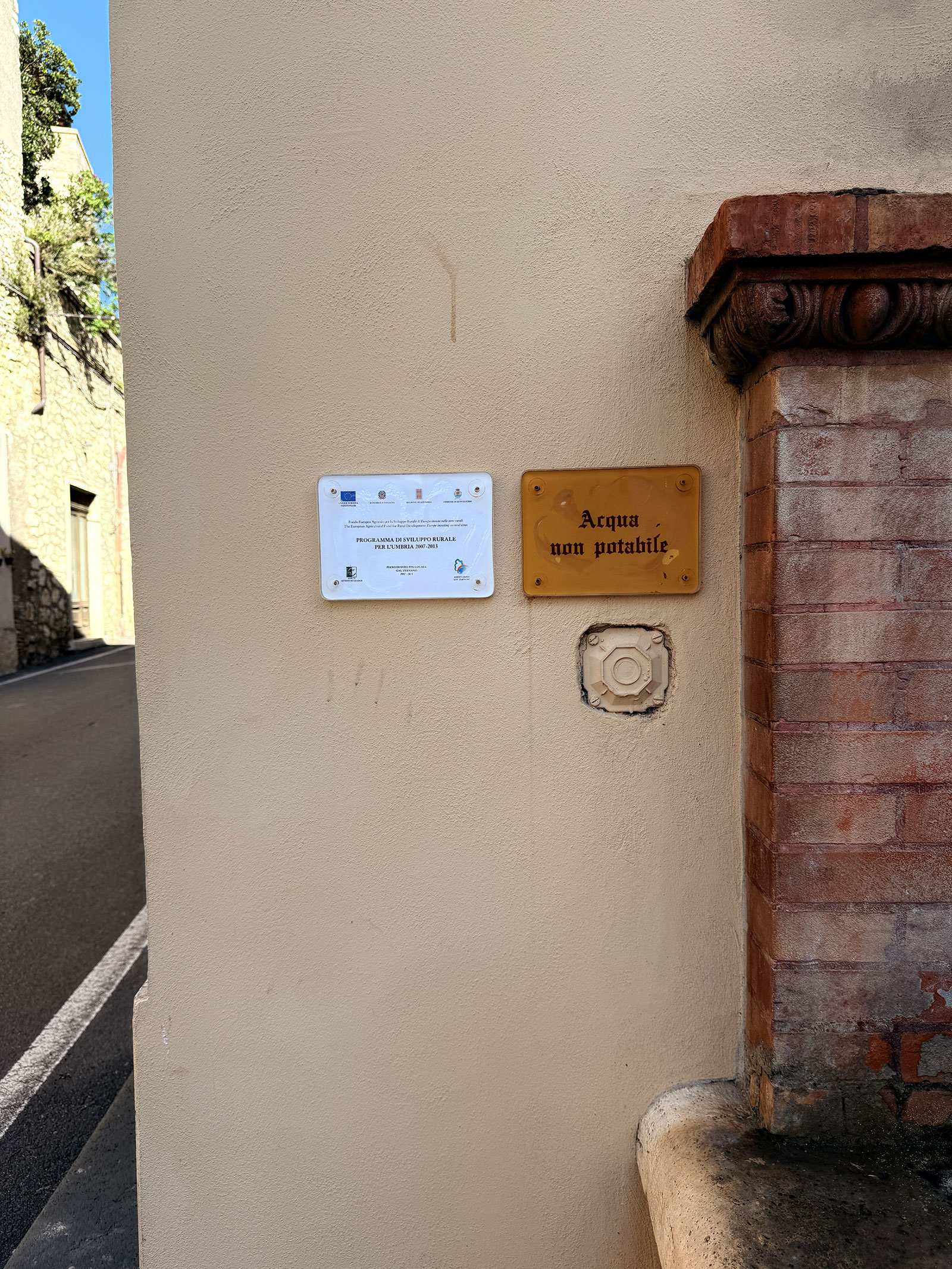
Just a few steps before the climb to the castle, the Fountain of Piazza della Concordia offers a scenic, symbolic pause: a semicircular basin with a crowning bowl, a brick aedicule with two lion heads spouting water, and a plaque that tells its story. Here, architecture meets village memory and the still-visible traces of ancient paths.
The Fountain of Piazza della Concordia
Leaning against a palazzo with an elegant loggia, the fountain features a semicircular basin from which rises a stem supporting a bowl (once a jet). The brick aedicule is flanked by two lion heads, which still pour water today.
At the centre, the plaque reads: “PRINCIPE E POPOLO / DI / MONTECCHIO / FECERO AD MCMXXV” — “Prince and people of Montecchio made this in 1925.”
The basin was made using spolia from the former Church of the Carmine: first placed in Piazza Garibaldi, it was later moved here, where it became the architectural heart of the square.
The square’s story: a community-built open space
Between the mid and late 19th century, at the initiative of Atanasio Bastianelli and with the voluntary work of many townspeople, an open space was created beside an old spring and given the auspicious name “Concordia”. A few years after the demolition (1924) of the Church of the Carmine, the new fountain carved from its stones was first set in Piazza Garibaldi and then brought here, marking the passage between the village and the ascent to the castle. It’s a story of civic participation, thoughtful reuse of materials, and shared memory.
A trace of ancient hospitality
On the house to the right of the fountain (as you face it), two carved symbols stand out: on the left the Flower of Life, on the right a Cross pattée, traditionally linked to the Templar Order. According to oral tradition, a small hospitale (pilgrims’ hostel) once stood here: these signs may be the trace of a place of welcome outside the walls, at the threshold of the climb to the fortified town.
Urban walk
A water stop along the urban route
If you’re following the urban trek, pause to observe the bowl, the lion heads and the 1925 plaque, then look up to the two symbols on the house to your right. When you’re ready, continue towards the Tower, the ancient gate to the castle, or head to the Capponi Museum.